Public Speaking Tips for Photographers Who Teach with Heather McGuigan
Do you need to be a natural to be a great speaker? Nope. Heather McGuigan, a professional theater actor and accent and public speaking coach based in Stratford, Ontario, says knowing your content and being a good speaker are two completely separate skills. The best public speaking tips for photographers start before you ever open your slides, with three questions she asks before every talk.
I had Heather on The Reinvent Podcast because, honestly, I’ve given talks where every single word was on my slides. She taught a class in my mastermind, and I scrapped half my notes because I was too busy scribbling in the margins. Here’s what she taught me about what to do before your next talk, what to cut from your deck, and how to own the room once you’re up there.
Who Is Heather McGuigan?
Heather is a professional theater actor who coaches speakers under the name Speakeasy with Heather. She works one-on-one on two things: accent modification for people speaking English as a second language, and public speaking.
Her eye for this comes from audition rooms. Picture a dance call with 50 or 60 performers in one room. She says you can tell within seconds who’s calm, who’s forcing a joke, and who’s more nervous than they need to be.
She knows bad habits firsthand, too. Her dad was a school headmaster who did a lot of public speaking and filled his pauses with “aw.” She picked it up in her early years and had to practice undoing it.
Why Isn’t Knowing Your Content Enough to Be a Great Speaker?
Because teaching well and presenting well use different muscles. Heather compares it to a performer who can nail a triple and hit a high note but has no stagecraft, so nobody can hear them or the mic blows out. As photographers, we get this: a single portrait and a huge family group are both “taking a photo,” but the dynamic is totally different.
She breaks speaking into three areas most of us have never studied:
- Your voice. How it works, how to warm it up, why it sounds raspy, shaky, or nasal, and what projecting actually means (it’s not yelling).
- Your body. Fast gestures, the same gesture on repeat, pacing back and forth, hunching, or suddenly not knowing what to do with your hands.
- Your space and audience. Looking down from a huge stage versus up from an auditorium floor, a creaky convention platform, slippery heels, and a mic you’ve never held before.
Can you get better just by speaking more?
Not on its own. Heather compares it to running 5Ks with bad form: you’ll keep running, but you won’t become a better runner. Repetition helps with nerves, but a little training is what fixes the habits causing them.
What Should You Ask Before Every Talk?
Heather starts every client with the same three questions:
- What do you want? Write a one-sentence, active thesis for your talk, like “I want people to buy my course” or “I want people to start their own businesses.” Every story and fact should prove that goal. If it doesn’t, cut it.
- Why do you want it? To grow your business? To support other photographers? Your why shapes your vocabulary and your vibe. A support-system talk uses very different words than a “come work with me” talk.
- What should the audience do? Think, take notes, raise hands, ask questions, sign up afterwards? Once you know, build it in: budget time for questions, plan your yes-or-no prompts, leave silent space for thinking, or make a clear “now is the time” invitation.
This is the same work she does as an actor building a character. She even pointed to Hamilton, which runs with very little applause between numbers so the tension builds to a huge release at the end. Your talk can be designed the same way.
Should you show up the same way on every stage?
You stay you, just dialed for the room. Heather keeps three core values (hers are energetic, passionate, and driven) and treats them like DJ faders. For a crowd in their early twenties, she might push the drive and dare them to be first. For an older crowd, she’d turn up the warmth and encouragement.
She also checks in with how she actually feels that day. If you’re feeling more encouraging than pushy, lean into that. Otherwise, the audience ends up watching you fight yourself on stage.
How Much Should You Put on Your Slides?
Less than you think. Heather’s test: ask yourself if you could give the whole presentation without the slides. If you’re saying what’s already on the screen, you don’t need it on the screen.
She gets why we do it. We’re visual people, slides are the world we know, and standing on a stage is vulnerable. When she said this, I literally blurted out, “But that’s my safety net!”
Use slides for what words can’t do well, like a graph or the look of a photograph. Then people glance up, get the information, and come back to you. Otherwise, as Heather put it, someone asks how the speaker was and the answer is “I don’t know, but the slides were good.”
What Public Speaking Tips Help Photographers Who Talk Too Fast?
Don’t try to slow down. Lean into your words instead. Heather says 60 to 70 percent of her public speaking clients talk too fast, often because of nerves or not being clear on their point (I like to blame being Italian).
Why does leaning into your words work?
When you tell someone to slow down, the life drains out of their voice and face. Heather calls the fix diction, and it’s not just enunciating. It’s making a meal out of every word you chose, so slowing down becomes a byproduct and your pauses feel intentional instead of lost.
For a masterclass in holding a room, she recommends Mike Birbiglia’s Netflix special, The Old Man and the Pool, where he can stay still and keep everyone in the palm of his hand.
How do you stop saying “um”?
Replace it with a breath. A few ums make you human, but when you feel a pause coming, breathe instead. Heather says it helps your voice, calms your brain, and even steadies shaky hands.
What should you do if you lose your place?
Grab your water. It buys you a reset and makes you relatable (half the room will reach for theirs too). Just don’t try to sneak a sip. Heather’s rule: make a moment of it.
Why do you yawn when you’re speaking?
Yawning usually means you’re not breathing enough while you talk, so your lungs crave oxygen and your jaw gets tense. It doesn’t mean you’re bored. This one blew my mind, because I yawn on stage all the time and always worried people would think I was tired.
What Should You Do With Your Hands When You Speak?
Save your gestures for the words that matter most. Heather borrows a theater saying: when you can’t speak anymore, you sing, and when the emotion is too big to sing, you dance. Make a list of roughly 20 key words in your talk, and those are the ones that get a gesture.
The rest of the time, find a home base. Her go-to is “church choir hands,” held together just below your chest. On camera (podcasts, video), keep gestures sideways and open, never pushed toward the lens.
How Do You Prepare for the Room Before You Speak?
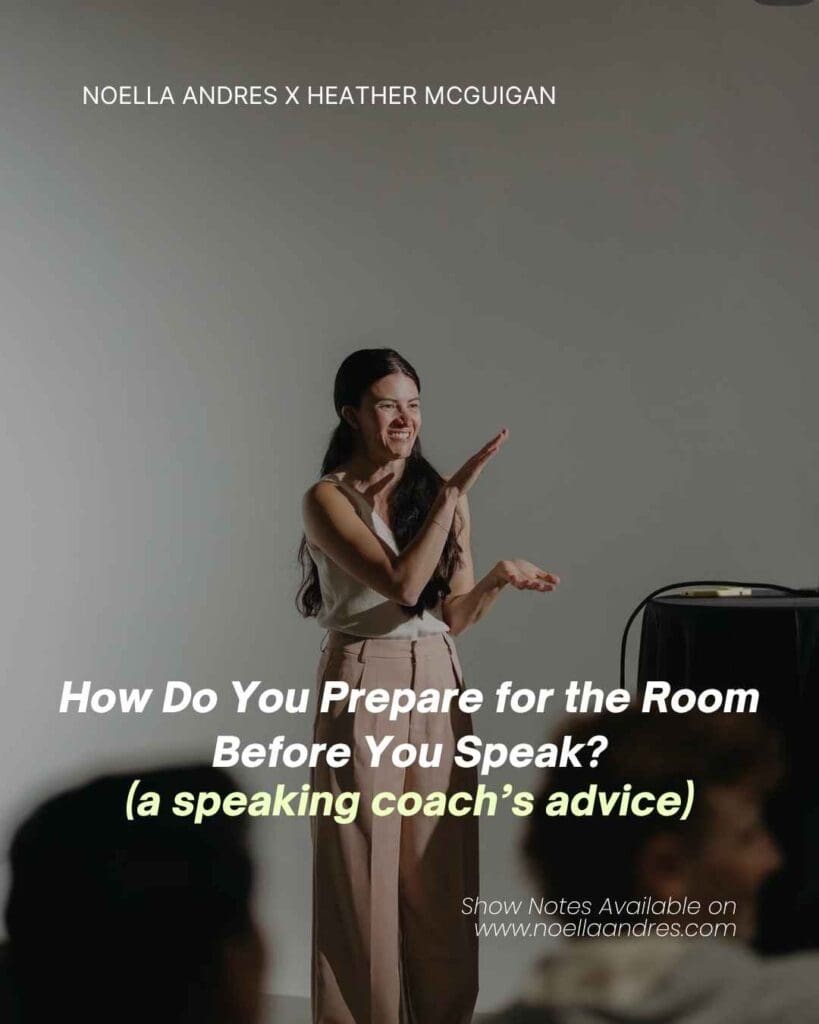
Scout everything you can control before you walk onstage. If you’re not the first speaker of the day, sit in the audience and find the worst seat in the house, then make sure you include that person when you speak. Notice how high the stage is, whether it echoes, and what sounds or lights might startle you.
Which microphone should you choose?
If you get a choice, take a handheld. Heather’s checklist:
- Handheld over headset. You control a handheld. A headset (the “Britney mic”) sits in front of your mouth the whole time and picks up everything.
- Practice with a cord. Never held a corded mic? Practice at home so you’re not tripping over it.
- Dress for the pack. A headset comes with a pack, so wear something it can clip to.
- Test your seat. If you’ll be on a stool, sit on it first so you know where your legs go.
My own version: before one of my last talks, I had my best friend take a photo of me on the stage so I could see what the audience (and all those photographer cameras) would see.
What Should You Do Right After You’re Accepted to Speak?
Get genuinely excited. Heather says to talk yourself into wanting the conference to be tomorrow, by reminding yourself what you’re great at and why you care about your topic. People aren’t just coming for your content. They’re coming for you.
Then write your thesis statement. She compares it to a wedding where the couple falls for one gold candlestick and builds the whole day around it. Once you have that one central goal, your slides, outfit, words, and movement all fall into place.
What Can You Do This Week?
- Write your one-sentence thesis. Answer Heather’s three questions for your next talk: what you want, why you want it, and what the audience should do.
- Run the no-slides test. Go through your deck and cut anything you’d say out loud anyway.
- Swap one um for a breath. Notice your next pause on a call or in your stories, and breathe instead of filling it.
Heather coaches one-on-one, from general speaking skills to polishing one specific talk. Find her at speakeasywithheather.com or @speakeasywithheather on Instagram. If you want the full conversation (including how I accidentally pulled a Justin Bieber on stage, and why Heather is “Bieber adjacent”), listen to the full episode on The Reinvent Podcast. Now go press play, then go write that thesis. 🎤